


Kalpana Jha and Uma Jha launched JhaJi Store in 2021 with a simple idea: bring traditional Mithila-style pickles and chutneys to a wider audience. Their appearance on Shark Tank India soon transformed the visibility of their homegrown venture.
Entrepreneurship can begin with a business plan, an investment or years of industry experience. Sometimes, however, it begins with a skill developed at home over generations.
For Kalpana Jha and Uma Jha, the inspiration behind JhaJi Store came from traditional recipes and flavours closely associated with the Mithila region of Bihar.
The two sisters-in-law launched JhaJi Store in June 2021 to produce and sell traditional pickles and chutneys inspired by the culinary heritage of Mithilanchal. What began as a small venture in Darbhanga eventually gained national attention after the founders appeared on Shark Tank India.
Their pitch introduced the two first-time entrepreneurs to television audiences across India. Although they did not secure an investment during their appearance, the exposure had a dramatic impact on public awareness of the brand.
According to the founders’ account at the time, the business began receiving a surge in orders and enquiries after the episode was broadcast.
For the two women, the national spotlight was an unexpected new chapter in a journey that had started with family recipes and a desire to build something of their own.
A New Beginning After Years of Family Life
Kalpana Jha was 52 when she entered the world of entrepreneurship.
After her husband retired from government service, the family returned to their hometown of Darbhanga. Having spent many years moving between different cities because of her husband’s professional postings, Kalpana began thinking about what she wanted to do next.
She did not want her return home to mark the end of her professional ambitions.
During the COVID-19 lockdown, her children encouraged her to explore something that matched her interests and abilities.
Cooking was one of Kalpana’s strengths, and she was particularly familiar with traditional pickle-making methods associated with the Mithila region.
Her family suggested that she turn those skills into a business.
The idea soon began to take shape.
Kalpana invited her sister-in-law, Uma Jha, to join the venture. Uma was a teacher by profession, and together the two women began exploring how they could transform traditional recipes into products for a wider market.
JhaJi Store was born from that collaboration.
Why the Name JhaJi Store?
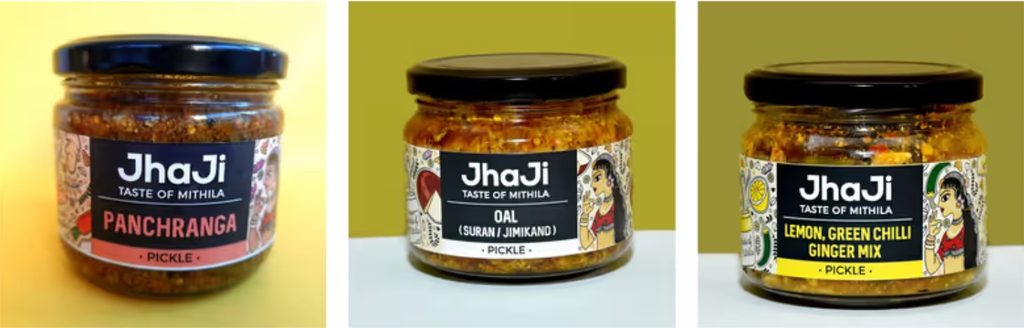
The name of the company was inspired by the founders’ surname and their cultural connection to the Mithila region.
The Jha community has strong historical and cultural associations with Mithila, and the founders saw the name as an extension of the identity they wanted the brand to represent.
The idea behind JhaJi Store was not simply to sell pickles.
It was to introduce customers beyond Bihar to traditional flavours associated with Mithilanchal.
That regional identity would become one of the central features of the brand.
Turning Traditional Recipes Into a Business
The founders did not immediately begin with large-scale production.
In the early stages, Kalpana and Uma prepared products in small batches and shared them with friends and family to gather feedback.
The response helped them gain confidence in the recipes and their potential as commercial products.
Once they received positive feedback, the founders reportedly began taking the formal steps needed to build a food business, including applying for the appropriate food licence.
The next challenge was production.
To begin with, the ground floor of Kalpana’s home became part of the business operation. From there, the founders started preparing products in larger quantities to meet anticipated demand.
Their range included traditional and familiar products such as lemon pickle, tamarind chutney, garlic pickle, ginger pickle and mixed chilli preparations, along with regionally distinctive offerings.
One of the brand’s goals was to preserve the traditional techniques associated with the preparation of Mithila-style food.
A Focus on Traditional Preparation Methods
According to the founders, JhaJi Store aimed to follow food-making practices inspired by the methods used by previous generations in their families.
The founders described a process involving locally sourced vegetables, sun drying and hand-prepared spices. They also said that mustard oil played an important role in their traditional recipes.
Uma previously explained the philosophy behind their products by saying that the brand followed the methods used by their mothers and grandmothers.
The founders emphasised that their products were based on traditional ingredients and preparation practices.
For a regional food brand, this emphasis on heritage can be an important differentiator.
Indian consumers increasingly have access to packaged food products from across the country. At the same time, there is growing interest in regional cuisines and products with a strong cultural identity.
JhaJi Store positioned itself within this space by highlighting the distinctive culinary traditions of Mithila.
From a Small Launch to Shark Tank India
When Kalpana and Uma appeared on Shark Tank India, they were still relatively new to the world of business.
Yet the founders impressed viewers with the confidence and preparation they brought to the pitch.
The Sharks asked them detailed questions about their business, but the sisters-in-law were ready to explain their operations and ambitions. Their use of terms such as average order value demonstrated how quickly they had become familiar with the language of entrepreneurship.
Their pitch did not result in an investment during the first season.
However, the television appearance gave JhaJi Store something that can be extremely valuable to an early-stage business: visibility.
According to Kalpana’s account, the response following the broadcast was overwhelming.
The brand began receiving significantly more orders, and people across India started recognising both the founders and their company.
The impact showed how a national television platform can change the trajectory of a small regional business, even when an investment deal is not immediately secured.
Overnight Recognition and Rising Demand
Before appearing on Shark Tank India, JhaJi Store was gradually building awareness among customers.
After the episode aired, the founders said demand increased sharply.
Kalpana explained that the volume of orders they had previously received over a much longer period was arriving at a far faster pace after the broadcast.
The sudden attention created a new challenge.
The company now had to increase production to keep up with demand.
At the time of the reported account, JhaJi Store had launched approximately 15 products, and demand increased significantly after the television episode.
The founders had to focus on producing larger volumes while continuing to maintain the identity and quality standards that formed the foundation of their brand.
Building Production Capacity in Darbhanga
As the business grew, its original production space was no longer sufficient.
The founders reportedly expanded their operations by taking up an additional facility of around 2,000 square feet near Kalpana’s home.
The workforce also grew, with a team of people supporting production and other operations.
The founders planned further expansion as demand increased.
For small food businesses, scaling can be one of the most difficult stages of growth. Producing a successful product in small batches is very different from manufacturing it at higher volumes while maintaining consistency.
JhaJi Store’s next phase therefore involved building the systems and production capacity needed to serve a larger customer base.
Bringing Mithila’s Flavours to a National Market
The founders’ larger ambition extended beyond pickles and chutneys.
They also discussed introducing more products associated with Mithilanchal and the broader food traditions of the region.
Potential additions reportedly included items such as sukhi vadis, makhana and other regional specialities.
The strategy reflects a growing opportunity for regional Indian food brands.
India has extraordinary culinary diversity, with every region offering distinctive ingredients, recipes and preservation methods. However, many of these traditional foods have historically remained local because they lacked modern packaging, distribution and national marketing.
Businesses such as JhaJi Store have the potential to bridge that gap by combining traditional recipes with contemporary food-business infrastructure.
A Family-Supported Entrepreneurial Journey
JhaJi Store’s early journey was also supported by the founders’ family.
Kalpana’s husband reportedly invested Rs 10 lakh in the business during its early stages. Her son, Mayank, an IIT Delhi graduate, also helped with areas such as marketing and distribution.
The combination of traditional knowledge and modern business support became an important part of the venture’s early development.
Kalpana and Uma brought knowledge of the products and their cultural roots, while the younger members of the family contributed support in areas connected with business growth and market access.
The collaboration allowed the company to build a bridge between generations.
Traditional recipes provided the foundation. Modern marketing and distribution offered the possibility of reaching customers beyond Bihar.
A Business Built on Confidence and Persistence
One of the most powerful aspects of the JhaJi Store story is the transformation of its founders.
Both women entered entrepreneurship after spending years in very different roles.
Kalpana had been a homemaker, while Uma had worked as a teacher.
Neither had followed the conventional path often associated with startup founders.
Yet they learned the language of business, understood customer demand and presented their venture on one of India’s most visible entrepreneurship platforms.
Their journey challenged the belief that business opportunities belong only to the young or to people with formal corporate experience.
Kalpana and Uma started with knowledge they already possessed: traditional cooking and an understanding of the food culture they had grown up with.
They then learned how to turn that knowledge into a commercial venture.
More Than a Pickle Brand
The success of JhaJi Store is also connected to a broader story about regional identity.
For the founders, the products were closely tied to the traditions of Mithila.
The brand gave them an opportunity to take familiar recipes and introduce them to customers who may never have experienced those flavours before.
Their journey illustrates how local knowledge can become a business advantage.
In a highly competitive consumer market, a product with a clear cultural identity can stand out. Customers are often interested not only in what they are buying but also in the story, people and traditions behind the product.
JhaJi Store brought together all three elements.
The company was built by two women from Darbhanga, inspired by traditional recipes and driven by the ambition to bring the flavours of Mithila to a national audience.
Age Was Not a Barrier to Starting Something New
Perhaps the most inspiring part of Kalpana and Uma Jha’s story is that they began their entrepreneurial journey at a stage in life when many people may hesitate to start something entirely new.
Kalpana was 52 when she took the step toward building a business.
Uma also moved beyond her established career as a teacher to help develop the venture.
Initially, the founders had concerns about whether customers would respond positively to their products.
The growing interest in their business eventually gave them greater confidence.
Their story demonstrates that entrepreneurship does not come with a fixed age limit.
A new business can begin with an idea, a personal skill, a family tradition or a simple desire to build something meaningful.
For Kalpana and Uma, that beginning came through the flavours of Mithila.
From small batches prepared in Darbhanga to recognition across India after Shark Tank India, JhaJi Store’s journey shows how a traditional skill can be transformed into a modern entrepreneurial venture.
The sisters-in-law started with a deep connection to their regional food culture. They combined that knowledge with determination, learned the language of business and found an audience far beyond their hometown.
Their journey continues to offer a simple but powerful message: experience gained over a lifetime can become the starting point for something entirely new.