
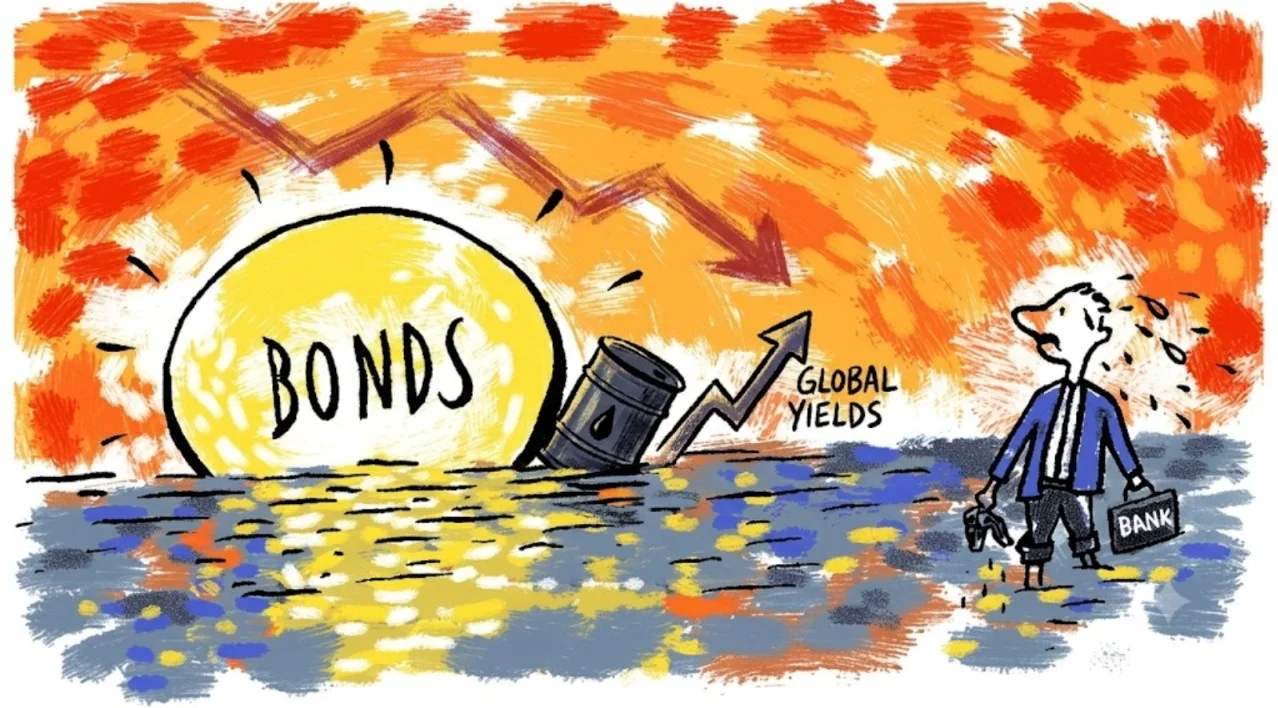

The benchmark 10-year government bond yield finished near 7.47%, while the rupee closed at 94.94 per dollar. Higher energy costs are complicating the outlook for inflation and borrowing costs.
Indian government bonds remained under pressure in the week ended October 23, with benchmark yields rising for a tenth consecutive week as elevated crude prices and global interest rates weighed on demand.
The benchmark 10-year yield settled near 7.47%, compared with approximately 7.46% in the preceding session. Business Standard described the run of weekly losses as the longest in three decades. That historical comparison is attributed to its reporting rather than an independently reconstructed bond-market series.
The rupee also weakened during the final session of the week. Together, the moves highlight how energy prices, inflation expectations and international capital flows can put simultaneous pressure on India’s debt and currency markets.
Rising yields mean falling bond prices
The distinction between prices and yields is essential to understanding the sell-off.
An existing fixed-rate bond generally becomes less attractive when investors can obtain a higher yield elsewhere. Its market price must fall to offer a more competitive return to a new buyer.
For example, a bond’s contractual coupon does not increase simply because its market yield rises. Instead, the price paid for its remaining payments changes.
This explains why rising government bond yields are described as a losing streak for the bond market. It does not mean every bondholder has suffered the same loss, or that a government bond has stopped making its scheduled payments.
The effect varies with maturity, coupon and duration—a measure of sensitivity to changes in yields.
Expensive oil adds to inflation concerns
Elevated crude prices present a challenge because their effects can spread beyond fuel markets.
More expensive oil can raise import costs and increase expenditure on transport and petroleum-derived inputs. Businesses may absorb those costs, pass them to customers or combine both approaches.
The inflation impact depends on exchange rates, taxation, retail pricing decisions and how long the increase lasts. A short-lived price spike has different implications from a sustained rise.
For bond investors, the concern is whether persistent cost pressure changes the expected path of inflation and interest rates. If investors demand greater compensation for those risks, yields can rise further.
Global yields also matter. Higher returns on developed-market bonds can change the relative appeal of Indian debt, although currency exposure, hedging costs and investment restrictions influence the comparison.
Rupee ends the session at 94.94 per dollar
The rupee closed at 94.94 against the US dollar, compared with 94.83 in the previous session, according to the market report. A higher dollar–rupee quotation means the Indian currency has weakened.
The move matters for both importers and overseas investors.
An importer needs more rupees to meet an unchanged dollar payment when the currency depreciates. For a foreign investor holding rupee assets, exchange-rate movements can add to or reduce the return measured in dollars.
However, daily currency movements should not automatically be attributed to a single cause. Import payments, investment flows, hedging and changes in global risk appetite can operate at the same time.
Forex reserves fall to $721.02 billion
India’s foreign exchange reserves declined by approximately $5.01 billion to $721.02 billion in the week ended October 16, according to PTI reporting on RBI data. This is a separate reporting period from the October 23 market close.
The reported reserve components were:
| Component | Value |
|---|---|
| Foreign currency assets | $591.85 billion |
| Gold reserves | $105.80 billion |
| Special Drawing Rights | $18.58 billion |
| Reserve position with the IMF | $4.79 billion |
Figures are rounded. Source: PTI reporting citing RBI data.
The total was approximately $64.69 billion below the reported September 4 peak of $785.71 billion—a decline commonly rounded to $65 billion.
That change should not be presented as a direct measure of dollars sold to defend the rupee. Reserve values can also move because of exchange-rate valuation effects, gold prices and other transactions. The headline reserve total alone cannot isolate intervention.
What the sell-off means for investors and borrowers
Higher government bond yields can influence pricing across the financial system because sovereign securities provide a reference point for other borrowing.
The effect on a particular loan or corporate bond is not automatic. Credit quality, maturity, liquidity and the terms of the instrument also matter.
Existing debt-fund investors may experience changes in net asset value as portfolio securities are repriced. Funds holding longer-duration securities generally have greater sensitivity to yield changes than otherwise comparable shorter-duration portfolios.
For direct bond investors, holding to maturity and selling before maturity are different situations. Market prices matter immediately to an investor who needs to sell, while an investor retaining a fixed-rate bond continues to depend on its contractual payments and the issuer meeting its obligations.
A higher quoted yield therefore needs to be considered alongside price risk, investment horizon and liquidity needs.
What could change market conditions?
The next developments to watch include crude prices, international bond yields, inflation readings, currency volatility and demand at government debt auctions.
Evidence of easing energy costs could reduce one source of inflation concern. Stronger demand for government securities could also help stabilise prices. Conversely, persistent cost pressure or higher expected interest rates could keep yields elevated.
Specific forecasts for the rupee—including a move towards 95.25 per dollar—remain conditional market opinions. They are not established outcomes.
The immediate picture is one of pressure across bonds and the currency, with reserve data adding context. Whether that pressure eases will depend on the interaction of energy costs, monetary conditions and investor demand.
This article provides market news and explanatory analysis, not personalised investment advice. Market figures refer to October 23, 2026; reserve figures refer to the week ended October 16.